Selling Covered Calls: How They Work, and the Trade-Off Nobody Mentions
By The Pie , independent options and small-cap research
Published
The Pie is the Nickelpie research desk, not a licensed financial adviser. Nickelpie publishes educational analysis, not personalized investment advice.
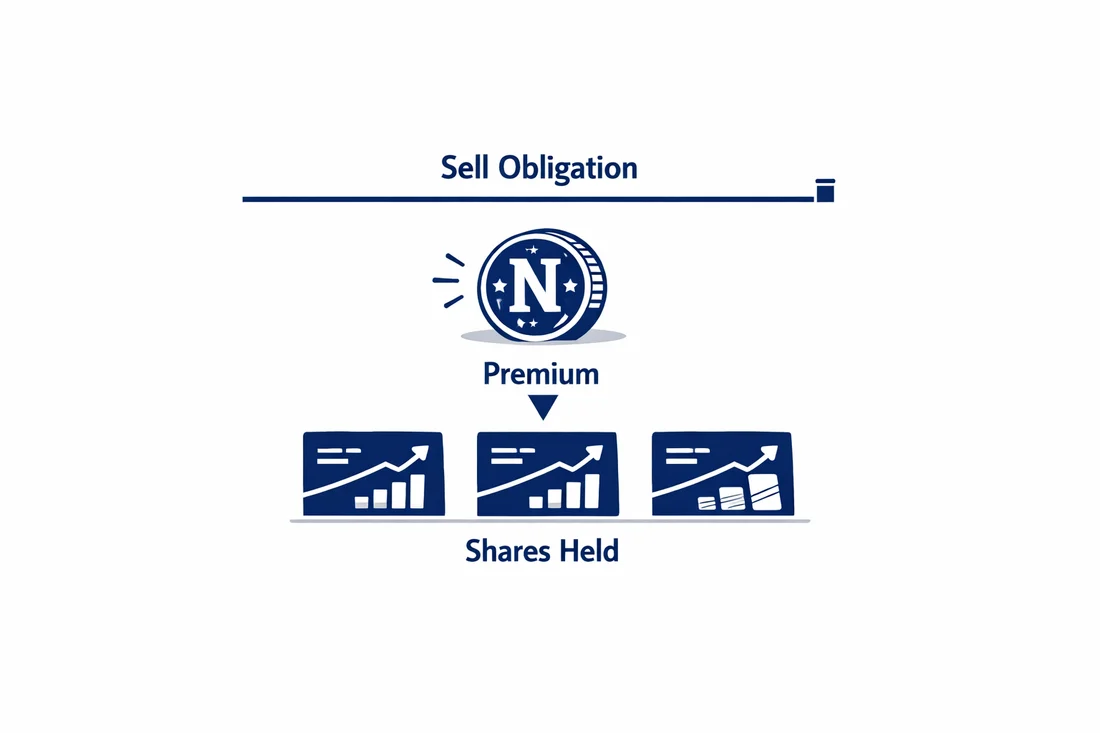
A covered call pays you cash today to promise you'll sell 100 shares you already own at a higher price. If the stock stays below your strike, you keep the cash and the shares. If it rises above, your shares are sold, at a profit, but you give up everything above the strike. The trade-off: you are selling your upside while keeping nearly all of your downside.
Back to the jacket
In the cash-secured put article, you promised to buy a jacket at $40 and got paid $3 for the promise. Say it dropped, you bought it, and your real cost was $37.
Now you own the jacket. You tell someone: "If this hits $45, I'll sell it to you." They pay you $2 today for that promise.
- It hits $45 → you sell at $45, having paid $37 and collected $2. Good outcome.
- It doesn't → you keep the jacket and the $2, and you can make the same promise again next month.
And the part the analogy hides: what if the jacket becomes a collector's item worth $200? You still sell it for $45. You promised.
A full example
Continue the hypothetical from the put article. You were assigned 100 shares of XYZ at $20, and because you'd collected $60 in premium, your effective cost basis is $19.40.
XYZ now trades at $21. You'd be happy to sell at $23. So you sell one call:
- Strike: $23 (above your $19.40 cost basis, this is non-negotiable)
- Expiration: 35 days out
- Premium: $0.70 per share = $70 cash, paid now
If XYZ stays below $23
The call expires worthless. You keep the $70 and you keep your shares. Your effective cost basis drops again, from $19.40 to $18.70. You've now been paid twice on the same shares. Sell another call next month.
If XYZ rises above $23
Your shares are called away at $23. Profit: ($23 − $18.70) x 100 = +$430. You're back to cash, and the wheel starts over.
If XYZ rockets to $40
You still sell at $23. You made your $430, but the person who simply held the shares made $2,100. You left $1,700 on the table, and there is nothing you can do about it, because you promised.
This is the honest cost of a covered call and it is why the strategy is not free money. You are renting out your upside. Most months, the rent is worth more than the upside you gave up. Occasionally it isn't, and that occasion is usually the one you'll remember.
The contradiction you'll hear repeated online
A lot of wheel content says some version of: "Never sell your shares, just hold forever and collect covered call premium."
Those two instructions contradict each other. A covered call is a promise to sell your shares. That promise is the product you're being paid for. You don't get to keep the payment and refuse the delivery.
You can roll a call, buy it back and sell a later one, to postpone assignment. Sometimes that works well. But a stock that's running hard makes rolling expensive, and rolling to avoid assignment can quietly turn a winning trade into a losing one.
If you truly never want to sell a stock, don't sell covered calls on it. Own it, and let it run.
The rules
- Never sell a call below your cost basis. Being called away should always be a win, never a forced loss.
- Only pick strikes you'd be genuinely happy to sell at. Assume you will be assigned. If that thought upsets you, pick a higher strike or don't sell the call.
- Remember the call doesn't protect you. If the stock falls, you lose, the premium barely dents it. Covered calls are an income strategy, not a hedge.
Common questions
What is a covered call?
You already own 100 shares. You promise to sell them at a price you choose (the strike) by a date you choose. Someone pays you cash today, the premium, for that promise, and you keep it regardless. "Covered" means you actually own the shares, so you can always deliver.
Do I need 100 shares to sell a covered call?
Yes, exactly 100 shares per contract. One option contract represents 100 shares. With 99 shares you can sell nothing. This is the hard constraint of the entire strategy, and it is why stock price matters so much for a small account: 100 shares of a $200 stock costs $20,000, while 100 shares of a $8 stock costs $800. See how much money you need.
What happens if the stock goes above my covered call strike?
Your shares get sold at the strike. This is called being called away. You keep the premium and every dollar of gain up to your strike, but you give up everything above it.
Sell a $25 call, and the stock jumps to $40 on a takeover? You still sell at $25. You made money, but you left $15 a share, $1,500 , on the table. That is the real cost of a covered call, and it is not hypothetical. It happens.
Can a covered call force me to sell shares I want to keep?
Yes, and this is the trade-off people underestimate.
You will see the advice "never sell your shares, just collect premium forever." That advice contains a contradiction. A covered call is a binding obligation to sell at the strike. That obligation is precisely what the premium is paying you for. You cannot collect the payment and refuse the obligation.
You can sometimes roll the call, buy it back and sell a later-dated one, to postpone assignment. But rolling isn't free, it isn't always possible at a good price, and a sharply rising stock can make it expensive.
The honest rule: only sell calls at strikes you would genuinely be happy to sell at. If you would be upset to lose the shares at $25, don't sell the $25 call.
What strike should I pick for a covered call?
Above your cost basis, always. Selling a call below what your shares cost you means that if you get assigned, you are forced to sell at a loss, and you did it to yourself, on purpose, for a small premium.
Beyond that: many sellers target a delta of 0.25 to 0.30, implying roughly a 70-75% chance the call expires worthless and they keep both the premium and the shares. But the more important filter is the one above, pick a price you would be happy to sell at.
Are covered calls actually safe?
Safer than most option strategies, but not safe. A covered call does nothing to protect you if the stock falls. Own 100 shares at $25, watch it drop to $15, and you have lost $1,000 whether or not you sold a call. A $50 premium offsets 5% of that. Meanwhile your upside is capped. Understand what you are actually trading: you are selling your upside, and keeping nearly all of your downside.
Keep going
- The wheel strategy, end to end
- Selling cash-secured puts, the other half
- How much money do you actually need?
Before trading options, read the OCC's Characteristics and Risks of Standardized Options. This article is educational analysis, not investment advice.