The Wheel Strategy, Explained From Scratch
By The Pie , independent options and small-cap research
Published
The Pie is the Nickelpie research desk, not a licensed financial adviser. Nickelpie publishes educational analysis, not personalized investment advice.
The wheel is two trades on repeat. Sell a cash-secured put on a stock you want to own and collect cash. If you're assigned the 100 shares, sell covered calls against them and collect more cash. When they're called away, start over. You get paid at every step, and you carry the full downside of owning the stock the entire time.
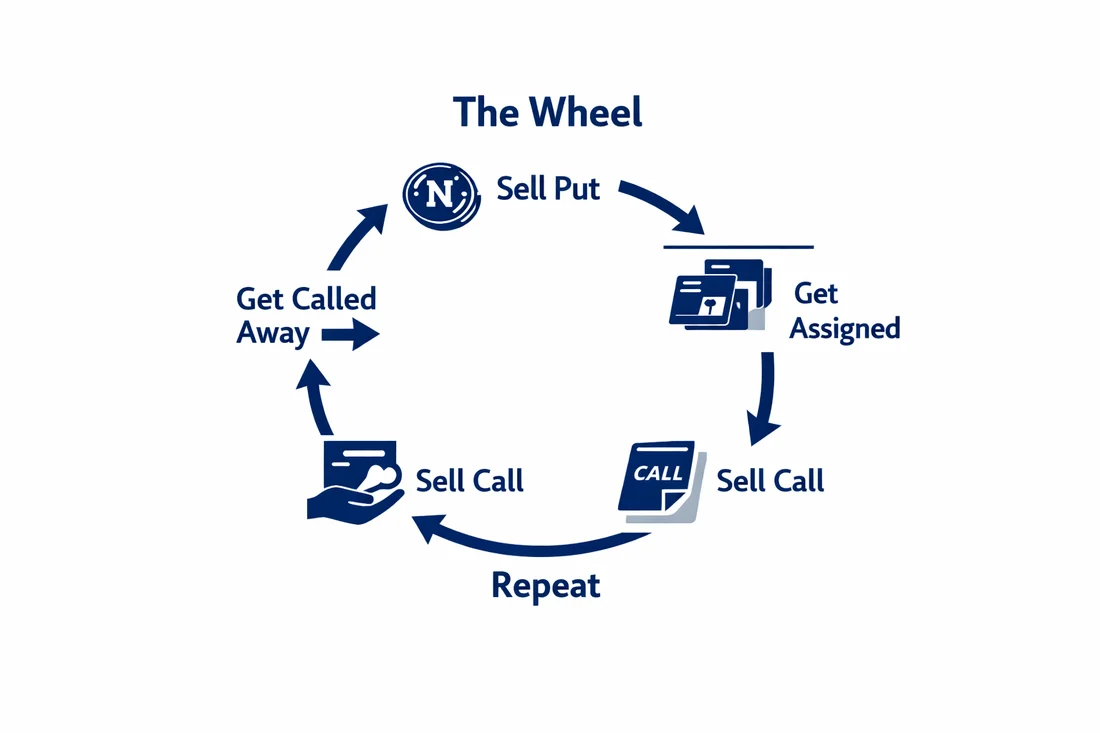
The loop
- Sell a cash-secured put at a strike you'd be happy to buy at. Collect premium.
- Stock stays above the strike? The put expires worthless. Keep the premium. Go back to step 1.
- Stock falls below? You're assigned 100 shares at your strike, cheaper than the market price when you started, because you keep the premium.
- Now sell a covered call at a strike above your cost basis. Collect more premium.
- Stock rises past it? Your shares sell at a profit. Back to cash. Go to step 1.
That's the whole strategy. Every other article about the wheel is commentary on those five lines.
A full turn, in dollars
Hypothetical stock XYZ, trading at $22. You'd happily own it at $20.
| Step | What happens | Cash |
|---|---|---|
| 1 | Sell the $20 put, 35 DTE | +$60 |
| 2 | XYZ dips → assigned 100 shares at $20 (cost basis $19.40) | −$2,000 |
| 3 | Sell the $23 call, 35 DTE | +$70 |
| 4 | XYZ rises → shares called away at $23 | +$2,300 |
| Profit on one full turn | +$430 | |
That's roughly 22% on the ~$1,940 actually at risk, over about 70 days, if it goes well. Which brings us to the part most wheel articles skip.
How the wheel actually goes wrong
You will see the wheel described as a strategy where "every outcome is one you'd be happy with." That is not true, and believing it is how people get hurt. There are two losing outcomes, and they are common.
Failure 1, the stock keeps falling (the expensive one)
You're assigned at $20. The stock goes to $13 and stays there. Now:
- You're down $640 on the shares, net of premium.
- Covered calls above your $19.40 cost basis pay almost nothing, the stock is 30% below them.
- Selling calls below your cost basis would lock in a loss if assigned.
So you hold a falling stock and collect nearly nothing. The wheel has stopped turning. There is no clever escape from this, it is simply the risk you were paid $60 to accept, arriving.
Failure 2, the stock rockets (the annoying one)
You sold the $23 call. The company gets a takeover bid at $40. You still sell at $23. You made $430, and you watch $1,700 walk away.
Less painful than Failure 1, but it is exactly why the wheel underperforms simply owning good stocks in a strong bull market. You are systematically selling your winners early.
What the wheel is, honestly
Not a money machine. Not passive income. Not "every outcome is a good outcome."
The wheel is a way to get paid for being patient, on stocks you genuinely want to own, in exchange for giving up your biggest winners and keeping your biggest losers. It wins small and often. It loses rarely and large. Whether that suits you depends entirely on whether you actually wanted to own the stock in the first place, which is why every rule below reduces to that one question.
The rules
- Only wheel stocks you genuinely want to own. Everything else is a footnote to this.
- Keep the cash fully secured. Strike x 100. No margin while learning.
- Fat premium is a warning, not a gift. High implied volatility means the market thinks it can fall hard. It is usually not wrong.
- Never sell a call below your cost basis. Being called away should always be a win.
- Size so one bad assignment doesn't define your year. If a 40% gap down would ruin you, the position is too big.
- Don't trust a stop-loss to define your downside. Stocks gap. See the FAQ below.
Common questions
What is the wheel strategy?
Two trades, on repeat. Sell a cash-secured put on a stock you want to own, and collect premium. If the stock stays above your strike, keep the premium and do it again. If it falls below, you're assigned 100 shares. Then you sell covered calls against those shares, collecting more premium, until they're called away at a profit, and the wheel starts over.
Is the wheel strategy actually profitable?
Yes, in the conditions it was built for: flat, drifting, and mildly falling markets, which is most markets, most of the time. Premium typically runs 1-3% of collateral per 30-45 day cycle.
It loses in two situations, and any honest description names both:
- The stock falls hard and keeps falling after you're assigned. You now own a loser, and covered calls above your cost basis pay almost nothing.
- The stock rockets up after you sold a covered call. Your gain is capped at the strike while everyone else rides it.
The wheel quietly wins small, often, and occasionally loses big. That is the actual shape of it.
What happens if the stock keeps falling after I am assigned?
This is the wheel's main failure mode, and it deserves a straight answer.
You own 100 shares that are underwater. Covered calls at strikes above your cost basis now pay almost nothing, because the stock is far below them. Selling calls below your cost basis would lock in a loss if you're assigned.
So you are holding a falling stock, collecting negligible premium, waiting. There is no clever manoeuvre that fixes this. This is the risk you were paid to accept, and it is why the first rule is to only wheel stocks you would genuinely be content to own for a long time.
Does a stop-loss protect me when running the wheel?
Not as much as people claim, and this matters.
You will read that a trailing stop-loss makes your downside "known" or "defined." It does not. A stop-loss is an instruction to sell at the next available price, not at your stop price.
If a stock closes at $20 with your stop at $18, and overnight it announces a failed trial, a fraud investigation, or a dilutive raise, it can open at $11. Your stop triggers and you are filled near $11, not $18. The stop did not define anything.
Gap risk is highest in exactly the small, volatile stocks that small accounts get pushed toward. Use stops if you like, they are a genuine risk-reduction tool. Just never believe they make your downside certain.
What delta and expiration should I use for the wheel?
Convention is a delta of 0.25-0.30 and 21-45 days to expiration. The delta range implies roughly a 70-75% chance the option expires worthless; the DTE window captures the fastest part of time decay without tying capital up too long. But these are conventions, not laws, and delta is a model output that moves with volatility, not a promise.
Learn each piece
- Selling cash-secured puts, how you get in
- Selling covered calls, how you get paid to hold
- How much money do you need?
- Which broker should you use?
Before trading options, read the OCC's Characteristics and Risks of Standardized Options. This article is educational analysis, not investment advice. Options involve risk and are not suitable for all investors.